
To optimise a website for AI search, make sure your important pages are indexed and eligible for a normal Google snippet, explain each service clearly in page text, and measure what that visibility produces. Google states that no special file, markup or technique is required to appear in AI Overviews or AI Mode. The ordinary SEO foundations still apply.
That is the short answer. The longer one is about where a business should spend limited time, now that “GEO packages” are being sold with very little evidence behind them. I work on Google Ads, SEO and conversion tracking for businesses that live on enquiries, and this is my attempt to answer “do we need to do something about AI?” using Google’s own documentation, while being clear about what nobody outside Google can know.
Why the business question matters more than the AI tool
People now ask Google, ChatGPT, Perplexity and other assistants questions that used to start as a search, so it is reasonable to wonder whether your website will still be found. The wrong starting point is “how do I get cited by AI?” The right one is “what does a potential customer need to understand before they contact us?”
A loft-conversion company needs a page that says where it works, what projects it takes on, what happens at the survey, roughly how long a typical job takes and how to request a quote. A language school needs course types, start dates, levels, prices or at least a price range, and who each course suits. That information helps a person decide. It also gives Google’s systems something specific to retrieve when someone asks a related question.
Google explains that its AI features run several related searches behind the scenes (it calls this “query fan-out”) and pull pages from the normal Search index to ground the answer. Its example: a question about a weedy lawn fans out into searches about herbicides, chemical-free removal and prevention. For a business, the lesson is that one clear, complete page about a service can be retrieved for many phrasings of the same need. You do not need twenty near-identical pages, and Google says creating them mainly to manipulate AI responses breaks its scaled content policy. Google’s guide to optimising for generative AI
AI search visibility is not an outcome on its own. A business should care whether the right person visits, enquires and becomes a customer.
A three-part check: access, clarity, measurement
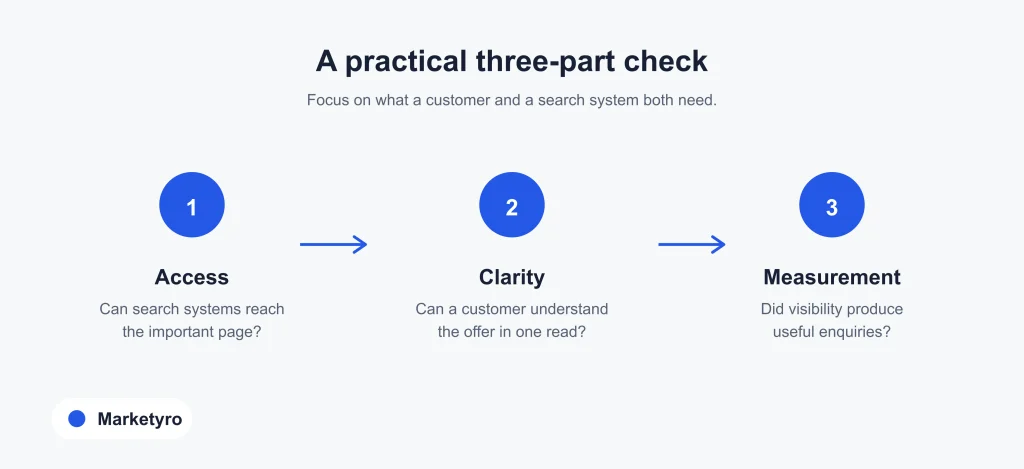
You can run this on one service page in an afternoon. Do it before writing anything new.
1. Can Google reach, index and show the page?
Google’s rule for its AI features is simple to state: to be eligible to appear as a supporting link in AI Overviews or AI Mode, a page must be indexed and eligible to be shown in Google Search with a snippet. There are no additional technical requirements. Google: AI features and your website
There is also one setting most businesses have never seen. Since 31 August 2026, every Search Console property has a “Search generative AI” control under Settings. The default is “include”, but a site can be set to “exclude”. If someone excluded yours at some point, you will not appear in AI Overviews or AI Mode however good the content is. Search Console help: Search generative AI control
So the access check is:
- Confirm in Search Console that the page is indexed and the generative AI control is set to include.
- Check robots.txt and any security plugin or CDN rules, so you know which crawlers you block and why, rather than inheriting a developer’s default.
- Make sure the explanation of the service is real page text, not only inside an image, a PDF, a slider or a video.
- Give the page a clear title, one main heading and internal links from related pages.
- Check it on a phone, including the enquiry form.
Google lists crawlable pages, internal links, good page experience, text content and structured data that matches the visible text as the things that still matter for its AI features. This is not “AI-only SEO”. It is website hygiene.
2. Can a person understand the offer in one read?
Many sites make the visitor work too hard. They say “tailored solutions” and never say what the service is, who it is for, where it is available or what happens next. Each important service page should answer those five questions: what, who, what problem, where, and what happens if someone enquires.
Here is the difference on a language-school page. Before: “We offer a wide range of high-quality language courses for every level, delivered by experienced native teachers in a friendly environment.” After: “Intensive Spanish, 20 lessons a week, Monday to Friday mornings, levels A1 to C1, new groups start every Monday. Most students on this course are adults aged 25 to 45 preparing for work or relocation. Book a free level test and we will recommend a start date.” The second version answers a real question. It also gives a search system something concrete to match against.
Google calls the first kind of writing commodity content: text that could have come from anyone. Its guidance says non-commodity content, with a point of view and first-hand detail, will likely do more for visibility than any technical tactic. For a business, first-hand detail is cheap: the questions customers ask on the phone, the mistakes they make before they call, the part of the process that surprises them. Use the words customers use, but do not repeat phrases to look optimised; Google says its systems understand synonyms, so you do not need every variation.
3. Can you see what the visibility produced?
Being visible only matters if it contributes to a business result.
Google now gives you a direct view of this. The generative AI performance report in Search Console shows how often links to your site appeared in AI Overviews and AI Mode, which pages, and the countries and devices involved. It reached all websites worldwide on 31 August 2026. Google Search Central: generative AI performance reports
The report is built around impressions: it tells you that you were shown, not what happened next. Pair it with Google Analytics for sessions and conversions on those pages, and with your own record of what each enquiry became. Was it the right customer? Did it turn into a quote, a booking, a student?
In my own work on conversion tracking, the gap is rarely the report. It is that the form, the phone call and the WhatsApp message are not recorded as conversions at all, so any conversation about visibility happens without a way to connect it to an enquiry. Fix that first and the AI question becomes measurable instead of theoretical.
What GEO means, and what Google says you can ignore
GEO stands for generative engine optimisation. You will also see AEO, AI SEO and LLM SEO. The names are new; the work underneath is mostly familiar. Google’s position is unusually direct: from its perspective, optimising for generative AI search is still SEO, and its guide now lists things you do not need to do for Google Search:
- Create llms.txt files, AI text files, special markup or Markdown versions of pages. Google Search ignores them.
- Break content into small chunks for AI. Google says its systems can read a page with several topics and show the relevant part.
- Rewrite content in a special way for AI systems, or chase every long-tail variation.
- Seek “mentions” across the web in an inauthentic way.
- Add a special schema.org type for AI. Structured data is still useful for rich results, but nothing extra is required.
Google’s guide to optimising for generative AI
Google is equally direct about vendors: no third-party tool has access to its ranking or AI systems, none can guarantee performance, and good advice either presents itself as opinion or cites official guidance. Google’s guidance on third-party SEO advice
If someone offers you an AI visibility package, three questions tell you most of what you need to know. What exactly will change on the website? What will you measure, and in which tool? How will you connect that to enquiries or revenue? A vendor who answers with a file, a score from their own dashboard and a promise of citations has answered none of them.
One limit I will state plainly: I can tell you what Google documents because Google publishes it. I cannot tell you how ChatGPT, Perplexity, Gemini or Copilot choose what to cite, and anyone claiming precise knowledge of that is guessing. The same clear, well-sourced, crawlable page is the sensible bet across all of them.
Do you need an llms.txt file?
No, not for Google. Google states that you do not need new machine-readable files or AI text files to appear in Google Search, including AI Overviews and AI Mode, and that creating one neither helps nor harms your visibility there.
Add one if another tool you use reads it. It should not be the centre of anyone’s plan, and it never replaces a crawlable site, specific service pages and working measurement.
Does Google penalise AI-written content?
No, not because AI was involved. Google’s concern is content generated at scale with little value for the reader, which can breach its scaled content abuse policy. Its guidance also makes a practical point: generative models predict likely words rather than retrieve facts, so AI output can contain errors, and everything, including titles, meta descriptions and image alt text, must be fact-checked by a person before it is published. Google’s guidance on AI-generated content
AI is useful for research, structure and a first draft. It cannot supply your prices, your process or the question a customer asked you yesterday. Before publishing, ask whether the page answers a real customer question, whether every claim is supported or clearly an opinion, and whether it contains anything a generic AI answer could not. If not, it needs more of you in it.
A priority order for most businesses
- Fix indexing errors, broken enquiry routes and the Search Console generative AI setting.
- Make each main service page specific: what, who, where, problem, next step.
- Record enquiries as conversions (forms, calls, WhatsApp) so visibility can be connected to results.
- Publish pages that answer the questions your customers already ask you, with your own detail in them.
- Keep business details and services consistent across your site and your Google Business Profile.
- Review the generative AI performance report monthly alongside your enquiry records, and treat AI search as one more discovery channel rather than a replacement for SEO, Google Ads or a good website.
Frequently asked questions
Is SEO still relevant for AI search?
Yes. Google says its generative AI features are built on its core Search ranking and quality systems, and that existing SEO best practices remain relevant. If a page cannot be crawled, indexed and shown with a snippet, it cannot appear in AI Overviews or AI Mode either.
Can anyone guarantee my business will appear in ChatGPT or Google AI answers?
No. Google says third-party tools have no access to its ranking or AI systems and cannot guarantee performance. Other AI platforms do not publish their citation rules. A business can improve eligibility, clarity and evidence; nobody can promise a citation, a ranking or a number of leads.
How do I check whether my site appears in Google’s AI features?
Open the generative AI performance report in Search Console. It shows impressions from AI Overviews and AI Mode by page, country, device and date. If the report does not appear, your site may not have enough impressions yet, or it may be excluded under Settings, Search generative AI.
Should I publish hundreds of AI-written articles to cover every question?
No. Google says creating many pages mainly to influence rankings or AI responses breaks its scaled content policy, and that a high volume of pages does not make a site more relevant. Start with the questions customers genuinely ask and add your own detail, examples and checking.
Where Marketyro fits
If you would rather have someone run this check with you, Marketyro offers an SEO audit that covers technical health, page targeting, internal linking and AI search visibility, and a separate AI visibility audit for businesses that want to focus on how their pages read to search systems and people. Both are done by me, directly. The output is a prioritised list of what to change on the site and how it will be measured, not a score or a promise.
Request an SEO audit or send a short message with your website and the service you want to grow. I will reply with the most sensible next step, which is sometimes “fix the form first”.